
Founders & Entrepreneurs
Make them understand. Make them care.
Investor pitches, client conversations, business storytelling and the moments when your idea needs to move somebody towards a decision.
Investors, clients and partners hear a lot of pitches. I help you explain what the business does, why it matters and what you want them to do next.
Bring your pitch or deck to a Room Review See an exampleWhat gets in the way
A great business. Hard to explain.
When you know the business inside out, it is hard to know what to leave out. The aim is a story people understand quickly and remember.
How we work on it
Message. Make the business understandable quickly.
How we work on it
Pitch and deck review. Making the story shorter, clearer and easier to present.
How we work on it
Question rehearsal. Practising the hard questions aloud before the real meeting.
How we work on it
Investor and client storytelling. Finding the problem, the value and the proof worth leading with.
Fictional teaching example
Same business. A faster way in.
A strong pitch doesn’t tell people everything. It tells them the problem, what you do about it and why it matters, quickly.
Before
“We founded the company in 2022 and have developed a platform with multiple features designed to improve operational efficiency.”
After
“Small teams lose hours every week chasing information. Our platform brings those decisions and updates into one place.”
A fictional teaching example. Not client work. No business results are claimed.
The after version names the problem first and the value second. It adds no claims or numbers.
- Start with the problem A listener recognises it before they hear anything about the company.
- Say the value in plain words “Multiple features designed to improve operational efficiency” becomes one clear benefit.
- Leave the history for later The founding date matters less than why the business matters, so it can come after.
The coach
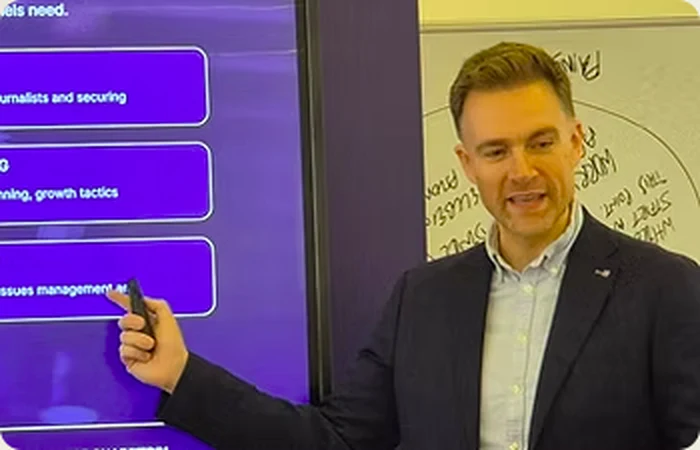
You know the business. I help others see it.
You’re too close to see what a stranger needs to hear first. My part is finding the problem, the value and the proof worth leading with, then helping you handle questions with conviction and without over-selling.
- 20+years in global business
- 1,700+people coached
Broad credentials across all my coaching, not a count of founders.
What that means for founders
- MessageMake the business understandable quickly.
- MindsetHandle difficult investor or client questions.
- PresenceCommunicate conviction without over-selling.
How we work
From a big idea to a clear pitch.
A practical process to find the story, test it against real questions and deliver it with conviction.
Discovery
Understanding the business and the audience.
We look at who you are talking to, what they need to believe and what you want them to do.
We start with the conversation you are about to have: an investor meeting, a client pitch, a demo day. I ask who is listening, what they already know and what would make them say yes. Then we look at your current pitch and where it loses people, such as a long history, a crowded deck or a point that arrives too late. You leave with one sentence about the problem you solve and for whom.
Development
Building a story people can repeat.
We shape the problem, the value and the proof into a pitch that moves quickly.
Now we build the pitch. We lead with the problem, state the value in plain words and choose the few proof points that carry the most weight. Everything else moves to the appendix or waits for questions. We also look at the deck, working out what each slide is for. The goal is a pitch someone could retell to a colleague accurately after hearing it once, without needing your slides.
Dynamics
Handling the hard questions.
We rehearse with the questions investors and clients actually ask.
This is where we test the story. You deliver the pitch aloud, and I ask the questions that expose gaps: why now, why you, what happens if a competitor moves. We practise short, honest answers, and we practise saying “I don’t know yet, and here is how I’d find out”. Preparing for the questions you dread tends to make the pitch itself steadier, because you are no longer bracing for them.
Delivery
Communicating conviction without over-selling.
We prepare the day and the close, so the pitch ends with a clear request.
The final stage is the pitch itself. We refine the opening, the pace and the closing request, and we agree a plan for the room: how you start, how you handle a tough question and how you finish. The aim is conviction that comes from clarity rather than volume. Afterwards we look at what landed and what to change, so each conversation improves the next. Each pitch teaches you something for the next.
Programmes
Three ways to work together
Choose the depth that fits the moment. Every programme starts with your material and your date, and the pricing depends on the project.
The Breakthrough Programme
8 sessions
Build the full investor story, rehearse the hard questions and take it into the room.
FrameworkAll four stages in depth
- Included: Video recordings
- Included: Notion workspace
- Included: Transcripts
- Included: Storytelling toolkit
The Momentum Programme
6 sessions
Sharpen the pitch and the answers around one funding or client moment.
FrameworkAll four stages, focused
- Included: Video recordings
- Included: Notion workspace
- Included: Transcripts
- Not included: Storytelling toolkit
The Spark Programme
4 sessions
Find the story and fix the biggest gaps in your pitch.
FrameworkThe core of the four stages
- Included: Video recordings
- Not included: Notion workspace
- Not included: Transcripts
- Not included: Storytelling toolkit
Not ready to choose? A Room Review is 40 minutes for £95, and the fee is credited against any coaching you book afterwards. Book a Room Review
Questions
Your questions, answered.
A pitch coach helps you find the one idea investors should remember, build the story around it and rehearse the hard questions out loud, so you can answer them without scrambling.
Yes. We work on the story, the order and the delivery, and on the questions investors are likely to ask. We work from your real deck and your real numbers.
Yes. Bring it as it is. We look at what each slide is for, what could move to an appendix and how the pitch sounds when you say it aloud.
No. Outcomes depend on the business, the market and the people in the room. I help you explain the business clearly and handle questions with confidence.
We list the questions you least want to be asked, then practise short, honest answers aloud. We also practise what to say when you don’t have the answer yet.
Free tools for founders
Your next pitch
You built the business. Let’s help people see it.
Bring the pitch, deck or conversation that matters. We’ll work out what needs attention and where to start. A Room Review is 40 minutes for £95. One focused challenge. Practical feedback. No obligation to continue.
Book a Room Review Or send a short briefFounders & Entrepreneurs
Make them understand. Make them care.
Investor pitches, client conversations, business storytelling and the moments when your idea needs to move somebody towards a decision.
Investors, clients and partners hear a lot of pitches. I help you explain what the business does, why it matters and what you want them to do next.
A great business. Hard to explain.
When you know the business inside out, it is hard to know what to leave out. The aim is a story people understand quickly and remember.
You try to explain the whole business.
Every feature and every milestone competes for attention.
Your pitch takes too long to reach the point.
People decide early whether to keep listening.
Questions expose gaps in the story.
A question can show where the logic is thin or the answer isn’t ready.
People like the idea but don’t take action.
Interest is not the same as a decision.
Same business. A faster way in.
A strong pitch doesn’t tell people everything. It tells them the problem, what you do about it and why it matters, quickly.
“We founded the company in 2022 and have developed a platform with multiple features designed to improve operational efficiency.”
“Small teams lose hours every week chasing information. Our platform brings those decisions and updates into one place.”
A fictional teaching example. Not client work. No business results are claimed. The after version names the problem first and the value second. It adds no claims or numbers.
What changed?
- Start with the problem
A listener recognises it before they hear anything about the company.
- Say the value in plain words
“Multiple features designed to improve operational efficiency” becomes one clear benefit.
- Leave the history for later
The founding date matters less than why the business matters, so it can come after.
You know the business. I help others see it.
You’re too close to see what a stranger needs to hear first. My part is finding the problem, the value and the proof worth leading with, then helping you handle questions with conviction and without over-selling.
- 20+years in global business
- 1,700+people coached
Broad credentials across all my coaching, not a count of founders.
What that means for founders
- MessageMake the business understandable quickly.
- MindsetHandle difficult investor or client questions.
- PresenceCommunicate conviction without over-selling.
Illustrative scenario · Not a completed coaching engagement
A business that took too long to explain.
The situation
A founder had a strong product and a deck full of detail. The pitch started with the company history and spent several slides on features before the problem appeared.
When investors asked questions, answers on pricing and competition were not ready, and the pitch ended without a clear request.
What the coaching would address
- Finding the one problem the business solves
- Leading with the problem and the value instead of the history
- Choosing a few proof points and leaving the rest for questions
- Rehearsing the hardest questions aloud
- Agreeing a clear closing request
What this scenario shows
How a pitch can become shorter and clearer, with answers ready for hard questions and a closing request people can act on.
This is a teaching scenario, not a statement of achieved client results. A real, permissioned case study will replace it when one is available.
From a big idea to a clear pitch.
A practical process to find the story, test it against real questions and deliver it with conviction.

Discovery
Understanding the business and the audience.
We look at who you are talking to, what they need to believe and what you want them to do.
We start with the conversation you are about to have: an investor meeting, a client pitch, a demo day. I ask who is listening, what they already know and what would make them say yes. Then we look at your current pitch and where it loses people, such as a long history, a crowded deck or a point that arrives too late. You leave with one sentence about the problem you solve and for whom.
- Who are you pitching to, and what do they care about most?
- What do you want them to do at the end?
Development
Building a story people can repeat.
We shape the problem, the value and the proof into a pitch that moves quickly.
Now we build the pitch. We lead with the problem, state the value in plain words and choose the few proof points that carry the most weight. Everything else moves to the appendix or waits for questions. We also look at the deck, working out what each slide is for. The goal is a pitch someone could retell to a colleague accurately after hearing it once, without needing your slides.
- Write the problem and the value in two sentences.
- Give each slide one job, or move it to the appendix.

Dynamics
Handling the hard questions.
We rehearse with the questions investors and clients actually ask.
This is where we test the story. You deliver the pitch aloud, and I ask the questions that expose gaps: why now, why you, what happens if a competitor moves. We practise short, honest answers, and we practise saying “I don’t know yet, and here is how I’d find out”. Preparing for the questions you dread tends to make the pitch itself steadier, because you are no longer bracing for them.
- List the three questions you least want to be asked.
- Answer each aloud in two sentences.

Delivery
Communicating conviction without over-selling.
We prepare the day and the close, so the pitch ends with a clear request.
The final stage is the pitch itself. We refine the opening, the pace and the closing request, and we agree a plan for the room: how you start, how you handle a tough question and how you finish. The aim is conviction that comes from clarity rather than volume. Afterwards we look at what landed and what to change, so each conversation improves the next. Each pitch teaches you something for the next.
- Write your closing request in one sentence.
- Plan how you will start if the first question comes early.
What working with Richard looks like.
Coaching is individual and practical. It starts with your business, your audience and your date, not a standard course.
Every item below reflects the kind of work we can do together. What you use depends on what you need.
You don’t need to commit to a full programme to explore what needs attention.
Pitch and deck review
Making the story shorter, clearer and easier to present.
Investor and client storytelling
Finding the problem, the value and the proof worth leading with.
Question rehearsal
Practising the hard questions aloud before the real meeting.
Individual working sessions
Focused on your own material and your actual conversations.
Support for a pitch date
A demo day, funding conversation or client meeting you are preparing for.
Programmes
Three ways to work together
Choose the depth that fits the moment. Every programme starts with your material and your date, and the pricing depends on the project.
The Breakthrough Programme
8 sessions
Build the full investor story, rehearse the hard questions and take it into the room.
FrameworkAll four stages in depth
- Included: Video recordings
- Included: Notion workspace
- Included: Transcripts
- Included: Storytelling toolkit
The Momentum Programme
6 sessions
Sharpen the pitch and the answers around one funding or client moment.
FrameworkAll four stages, focused
- Included: Video recordings
- Included: Notion workspace
- Included: Transcripts
- Not included: Storytelling toolkit
The Spark Programme
4 sessions
Find the story and fix the biggest gaps in your pitch.
FrameworkThe core of the four stages
- Included: Video recordings
- Not included: Notion workspace
- Not included: Transcripts
- Not included: Storytelling toolkit
Not ready to choose? A Room Review is 40 minutes for £95, and the fee is credited against any coaching you book afterwards. Book a Room Review
Bring the pitch. Let’s work on it.
The Room Review
£95 · 40 minutes
A focused working session around one pitch, deck or conversation.
Bring a draft, a deck or just the way you currently explain the business.
We’ll identify what is already working, what needs attention and the most useful next steps.
Not ready for a session? Take the free Stage Intelligence Read
Practical ideas for founders
Three short exercises to try before your next pitch.
Leading with the problem
A listener who recognises the problem will listen to the solution.
Read the 60-second version
- Describe the problem as your customer would, not as you would.
- Say it in one sentence.
- Open with it, before the company history.
Choosing your proof points
A few strong points are easier to remember than many.
Read the 60-second version
- List everything that proves the business is worth backing.
- Pick the few a stranger would find most convincing.
- Keep the rest for questions.
Closing with a clear ask
People act when they know what you want from them.
Read the 60-second version
- Decide what you want the listener to do next.
- Write it as one plain sentence.
- Say it last, then stop talking.
Your questions, answered.
A pitch coach helps you find the one idea investors should remember, build the story around it and rehearse the hard questions out loud, so you can answer them without scrambling.
Yes. We work on the story, the order and the delivery, and on the questions investors are likely to ask. We work from your real deck and your real numbers.
Yes. Bring it as it is. We look at what each slide is for, what could move to an appendix and how the pitch sounds when you say it aloud.
No. Outcomes depend on the business, the market and the people in the room. I help you explain the business clearly and handle questions with confidence.
We list the questions you least want to be asked, then practise short, honest answers aloud. We also practise what to say when you don’t have the answer yet.
The Room Review is a focused, 40-minute paid working session. We take one real communication challenge, identify what is already working, explore what needs attention and establish practical next steps, and you receive written notes afterwards. It costs £95. If you would rather pay in euros or dollars, I can send an invoice in pounds, euros or dollars, or you can pay securely online.
You built the business. Let’s help people see it.
Bring the pitch, deck or conversation that matters. We’ll work out what needs attention and where to start.
Book a Room Review · £95Take the free Stage Intelligence Read
One focused challenge. Practical feedback. No obligation to continue.