
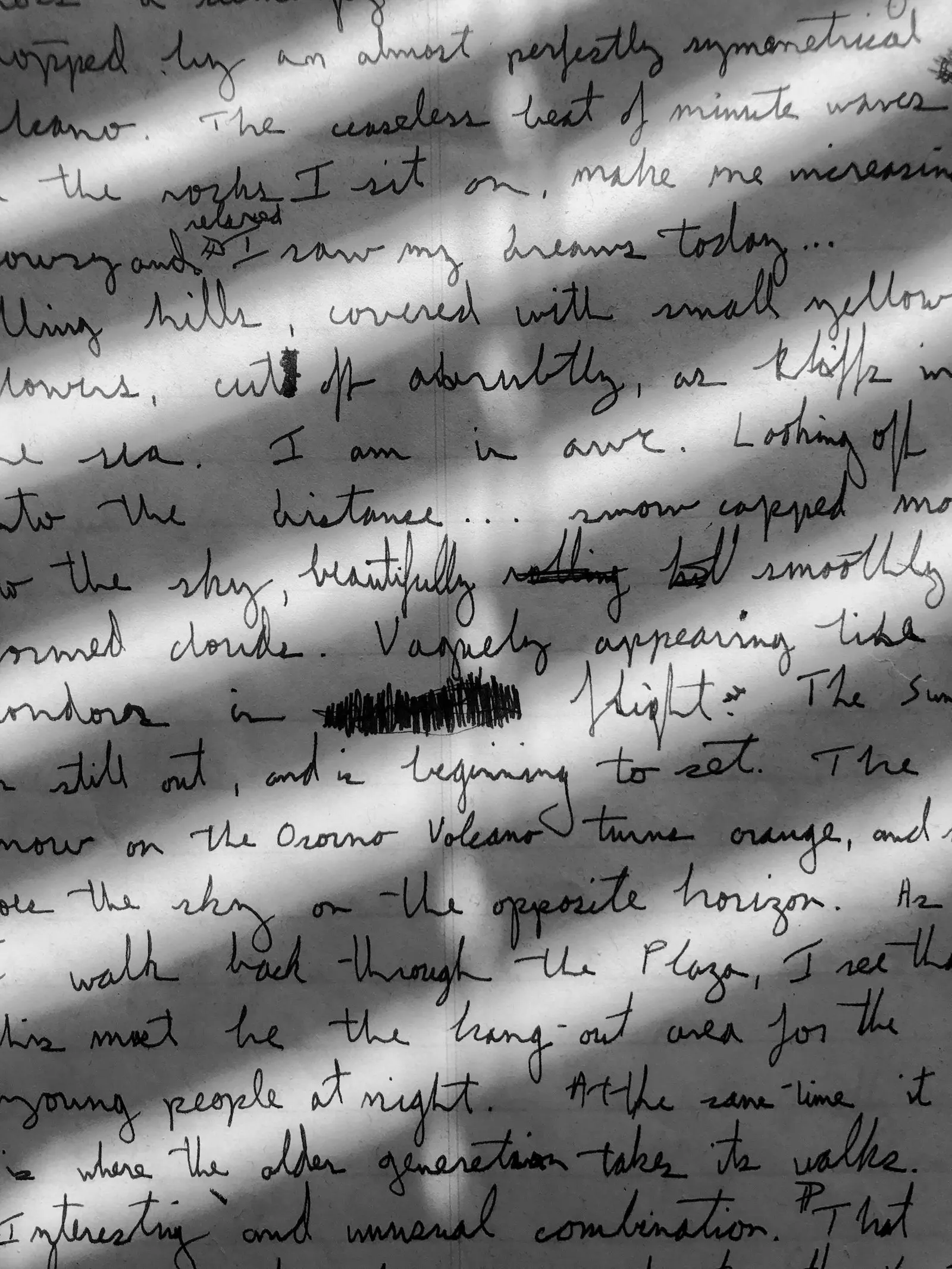
You wrote the script. You know what it says. And yet, halfway through the talk, your eyes slide off the page, you read the same line twice, skip a paragraph, and your voice goes flat as a pancake.
If that sounds familiar, you are not bad at presenting. You are doing something that is harder than it looks.
Why a script can make things harder
Reading aloud asks you to do two jobs at once. You have to read the words and perform them. For many speakers, that is fine. For fast-minded speakers, including many with ADHD, it can be a lot.
Speaking script
Big font, short lines, one thought each.
Landmarks
Headings and colour so you can find your place.
Route map
Headlines instead of every word.
A page of dense text also has no landmarks. Every line looks like every other line. Look away for a second to check the audience and your place has gone. And once you have lost it, the panic arrives before the recovery does.
Then there is the voice. When we read, we tend to flatten out. Sentences written for the page do not always sound right in the mouth. The audience notices, even if they could not say why.
This is a very common experience. It says nothing about how smart you are.
Try these before you throw the script away
- Make it a speaking script, not a document. Use a big font, short lines, one thought per line and plenty of white space. If you can read it from an arm’s length away, you are close.
- Add landmarks. Put a bold heading at the start of each section. Use one colour for the section titles and another for the line you most want to land.
- Cut the long sentences. If you cannot say a sentence in one breath, split it. Speech is shorter than writing.
- Mark the pauses. A simple slash where you want to breathe. It stops you rushing and gives your eyes a place to rest.
- Record it and listen back. You will hear exactly where you sound like you are reading. Rewrite those lines the way you would say them to a friend.
Then try letting the script go
For many speakers, the next step is a route map. Instead of every word, you hold a headline, one example and the line you want people to remember for each section. You speak around those markers, in your own words, and you have a clear place to return to if you drift.
This is not right for every situation. If you are reading a legal statement, a eulogy or a very tight timed piece, a full script may be exactly what you need. The point is to choose it, not be trapped by it.
Practise losing your place
Here is the bit most people skip. Deliberately stop in the middle of a section, look down and find your spot. Do it five or six times. It feels odd, and it works, because it turns a scary moment into a routine one.
The point is to choose it, not be trapped by it.
These are presentation strategies, not clinical advice, and different people need different things. Experiment, keep what helps, and drop what does not.
A script is a tool. It should help you stay on the road, not become the road.
Next step: If you are working out what kind of preparation suits how your mind works, a Room Review is a good place to start. We test approaches on a real talk, and you leave with a plan that is built around you.

Meet Richard
Business head. Performer’s instinct.
I’ve spent twenty years in the rooms I now coach people to walk into, working across operations, communications and leadership.
I didn’t start out feeling comfortable in them. I knew my subject. Feeling at ease in front of people was another matter.
Drama, stand-up, writing and improv taught me what changes when you stop clinging to the script and start connecting with the room.
That’s what I bring to our work: clear thinking, honest feedback and plenty of room to try things.
Serious about the work.
Room for your personality.
 Founder, Life Is A Speech